
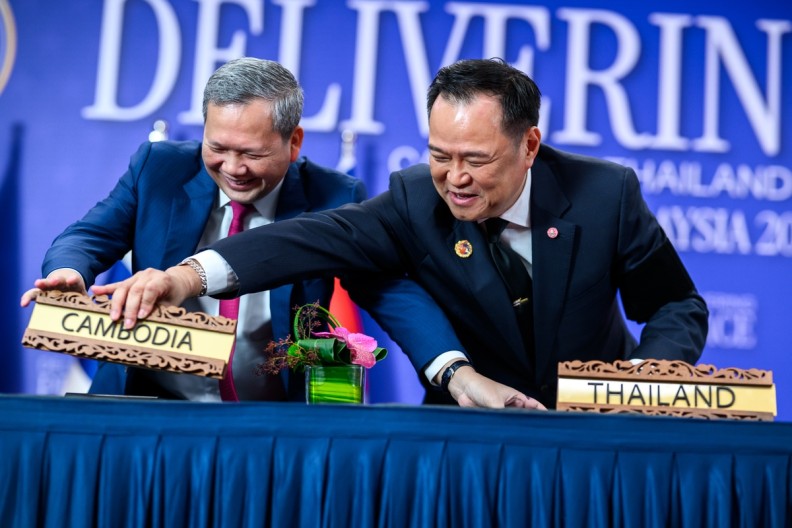
At the ASEAN Future Forum in Hanoi, Vietnam, Cambodian Prime Minister Hun Manet and Thai Prime Minister Anutin Charnvirakul exchanged greetings and engaged in a brief, informal conversation. This interaction occurred as the two leaders awaited the start of the two-day forum, offering a chance for informal dialogue amid ongoing regional diplomatic challenges. Photographs from the event showed the two leaders shaking hands outside the main venue, underscoring the continued engagement between Cambodia and Thailand despite unresolved border issues.
Political analysts in Cambodia interpreted the exchange as an indication of active diplomatic channels between the two neighboring countries. However, Thai officials were quick to clarify that the interaction was not a formal bilateral meeting but rather a routine conversation while waiting for the forum to commence. This incident highlights the complexities of regional diplomacy within Southeast Asia, where informal dialogues often play a crucial role in managing interstate relations.
The ASEAN Future Forum, now in its third iteration, convened regional leaders to focus on development priorities and enhance cooperation across Southeast Asia. During the forum, emphasis was placed on the necessity for ASEAN member states to adapt to global changes and embrace long-term growth strategies. Vietnamese leaders took the opportunity to stress the importance of moving beyond short-term political interests and placing innovation and younger generations at the forefront of future development plans.
Vietnam’s leadership urged ASEAN members to foster stronger regional cooperation, a strategy they believe is vital for navigating global challenges and seizing new growth opportunities. By promoting a united regional approach, they argued, ASEAN could better position itself to address the evolving global landscape and ensure sustainable development for its member states.