
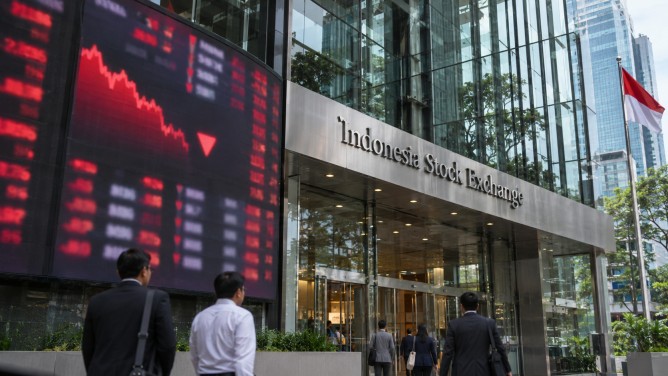
Indonesia’s stock market experienced a significant downturn on Tuesday, with the Jakarta Composite Index (JCI) dropping by 3.78% to 4,904 points. This decline was largely influenced by a sell-off from foreign investors and concerns surrounding the upcoming MSCI index review.
The market saw widespread losses, with 624 stocks falling, compared to just 57 that advanced and 37 that remained unchanged. The trading volume reached 27.15 billion shares, and transactions were valued at Rp 11.72 trillion, approximately $645 million. Foreign investors were a major factor in the market’s decline, recording net sales of Rp 831.5 billion during the first trading session.
Investors are cautiously awaiting the MSCI Index Review scheduled for November 11–12, which could impact the inclusion and weighting of Indonesian stocks in global investment indexes. Additionally, attention is focused on a meeting of Indonesia’s Financial System Stability Committee, expected to address stock market volatility, the weakening rupiah, and broader financial stability.
Domestic economic issues have further contributed to the negative sentiment in the market. Food inflation in Indonesia increased to 5.81% in October from 5.03% in September, due in part to supply disruptions linked to El Niño-related weather conditions. Meanwhile, core inflation eased to 2.56% from 2.84%, raising concerns about weaker household spending, particularly among lower- and middle-income consumers.
Regional market weakness and uncertainty regarding global technology investments have also impacted investor confidence. Concerns over rising costs in artificial intelligence development and uncertain returns have led to selling pressure across several Asian markets.