
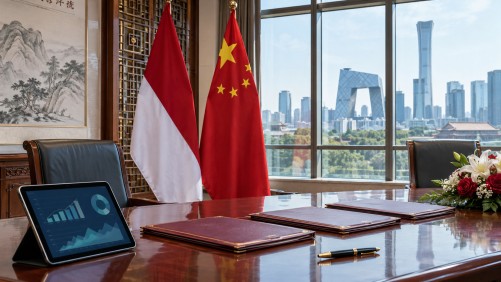
Indonesia has secured $86.8 billion in potential economic cooperation agreements following President Prabowo Subianto’s visit to China in November 2026. These agreements aim to enhance bilateral trade, attract investment, expand industrial production, and accelerate technological development between the two countries.
During the visit, a significant development was the signing of 35 memorandums of understanding (MoUs) valued at approximately $15 billion at the Indonesia-China Business Forum in Shenzhen on November 20. This adds to $71.8 billion in economic agreements announced earlier in the presidential visit. The agreements encompass strategic sectors such as renewable energy, petrochemicals, manufacturing, electric vehicles, digital technology, data centers, pharmaceuticals, infrastructure, and industrial development.
This growing partnership reflects Indonesia’s ambition to transition from merely exporting raw materials to establishing a more robust domestic manufacturing base. The Indonesian government is prioritizing investment in mineral processing, energy security, digital infrastructure, biotechnology, and logistics. The proposed projects from these agreements are expected to create over 30,000 jobs in Indonesia and support technology transfers, workforce development, and higher-value industrial production.
China continues to be Indonesia’s largest trading partner and a significant source of foreign investment, with bilateral trade reaching approximately $132.13 billion in the first nine months of 2026. Indonesian exports were valued at $55.47 billion, while imports from China amounted to $76.67 billion. In 2025, total trade between the two nations was $154.37 billion. Indonesia primarily exports ferroalloys, nickel products, coal, and copper-related materials to China, while importing machinery, electronic equipment, vehicles, and industrial products. Chinese investment in Indonesia was about $7.5 billion in 2025.
Mineral processing and energy development are central to the partnership’s growth. A notable initiative is an integrated electric vehicle battery ecosystem by the ANTAM-IBC-CBL consortium, which involves nickel mining, processing, battery material production, manufacturing, and recycling, with facilities planned in East Halmahera and Karawang. Additionally, cooperation in renewable energy is expanding, with Trina Solar partnering with PT Trina Mas Agra Indonesia to establish solar cell and module manufacturing in Central Java, supporting Indonesia’s solar energy supply chain.
Beyond these agreements, large-scale investment initiatives were highlighted, such as a $50 billion smart city development plan involving PT Kota Masa Depan Indonesia and a Chinese consortium. Consumer electronics company Hisense plans to invest around $10 billion to expand its Indonesian operations, including manufacturing facilities, R&D labs, and workforce training programs. Another significant initiative is a $10 billion infrastructure financing commitment between Indonesia’s Danantara and a consortium led by China’s State Development and Investment Corporation.
While these agreements present significant opportunities for strengthening Indonesia’s manufacturing capabilities, attracting international capital, and improving global supply chain positioning, turning these commitments into tangible economic growth requires consistent government support, transparent regulations, reliable infrastructure, and a skilled workforce. Ensuring technology transfer and adhering to environmental standards is crucial for sustainable industrial expansion.